
There's No Escape
Our daily experience fills us with it.

It is with us our entire life. It is expressed in many ways. But some of the most powerful expressions are often more of the subtle, 30,000 feet variety than those that we might encounter in a work of music.
And that is the parameter of music we call rhythm.
Rhythm all around us? Yes.
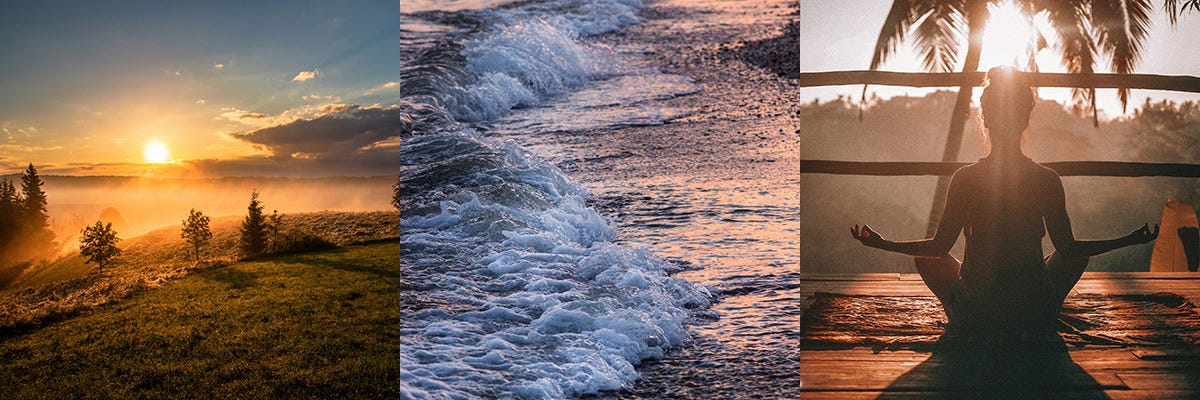
It is in the way that the world opens and closes our natural light on consciousness, with sunrises and sunsets.
It is in the way that, globally, our tides rise and fall.
And it is in the very breath we take, often without any thought at all.
We’ll be experiencing that, and much more in the exciting new course I’m developing on how to compose music one element at a time, titled ‘Parametric Music: Composition Through a New Lens.’
In our last episode, I talked about all that the element of pitch can do by itself is exist in musical space. It cannot move up or down, which is how pitch begins to imply melodic potential. Nor can it move to the right, expressing the passage of time … without the parameter of rhythm.
Both pitch and rhythm are huge when it comes to shaping our expectations as listeners. They are as importantly powerful tools for the composer and performer alike.
Try this
This may take varying amounts of time to do, in light of whether you’re working on a DAW, or with more traditional means.
On Your DAW
Take any loop you love and make only one gap slightly longer … specifically, let’s say that you have one step in your looping sequence which has an eighth note duration. Change that duration … augment it, diminish it … it doesn’t matter. Don’t change notes, velocity, mix, or anything else.
On Your Keyboard … from manuscript, or from memory
Basically the same goal here. For the moment, though, let’s say that you’re going to work from manuscript. Re-transcribe your loop. At some point in the sequence, change a note’s rhythmic value from an eighth note to a quarter note. Everything after that adjustment will start to flow over your barlines in a different way.
Listen for a minute. Where does your body now feel beat 1?


It’s An Inside Job
Did you know that your own ‘comfortable’ listening/performing tempo is an outpicturing of your body’s own preferences?
Yep. Collectively, our most natural tapping/stepping range clusters around ~100–120 BPM … close to a relaxed walking cadence and typical resting breath cycles. So … it’s a body clock, not a style preference.
Try it
Walk normally, and count your steps for 30 seconds. Double your step count. That’s your personal “baseline BPM.”
Another inside job that is often done for us is our preference for how the parameter of rhythm is approached: what’s preferred as a listener, and what’s preferred as a composer:
Rhythm, Defined — 15 Ways Across the Centuries
Here’s an easy-access reference map that you can keep coming back to over time.
Each composer’s high-level approach to rhythm in each example, one representative work, and a one-click to listen to it.
Notice how each treats time differently—as breath, pulse, swing, process, texture.
Hildegard von Bingen (1098–1179) — Rhythm as breath-led chant: time follows the arc of sung prayer more than measured beats.
Listen: “O viridissima virga” — The Marian ConsortGuillaume de Machaut (c.1300–1377) — Mensural proportion: notated durations as architecture; isorhythm binding form.
Listen: Messe de Nostre Dame — Ensemble OrganumGiovanni Pierluigi da Palestrina (c.1525–1594) — Flowing counterpoint: softened pulse to keep words and polyphony clear.
Listen: “Sicut cervus” — VOCES8Claudio Monteverdi (1567–1643) — Rhythm in service of speech: recitative/aria where text dictates time.
Listen: “Tu se’ morta” — Scherzi MusicaliJ. S. Bach (1685–1750) — Motor rhythm: a steady tactus animating dance and counterpoint.
Listen: Brandenburg Concerto No. 3 — All of BachLudwig van Beethoven (1770–1827) — Rhythm as force: motives stretched and driven to shape drama.
Listen: Symphony No. 7 — II. Allegretto (RCO / Haitink)Frédéric Chopin (1810–1849) — Rubato: one hand the heartbeat, the other breathes freely.
Listen: Nocturne in E-flat, Op. 9/2 — Vadim ChaimovichClaude Debussy (1862–1918) — Fluid color: meter loosens; time drifts with timbre and image.
Listen: La mer — RCO / HaitinkIgor Stravinsky (1882–1971) — Primal structure: layered accents, blocks of time, pulse as organism.
Listen: The Rite of Spring — LSO / RattleDuke Ellington (1899–1974) — Feel: without swing, the center won’t speak.
Listen: “It Don’t Mean a Thing (If It Ain’t Got That Swing)” (1932)Olivier Messiaen (1908–1992) — Ordered duration: additive/asymmetrical, sometimes non-retrogradable.
Listen: Quatuor, I. “Liturgie de cristal”John Cage (1912–1992) — Structure-in-time: form measured by time lengths; sound/noise both welcome.
Listen: First Construction (in Metal)Steve Reich (b. 1936) — Audible process: phasing and pattern clarity you can hear unfolding.
Listen: Clapping Music — NonesuchGyörgy Ligeti (1923–2006) — Texture as rhythm: microrhythms fuse into moving sound-masses.
Listen: Atmosphères — Berliner Philharmoniker / HardingCaroline Shaw (b. 1982) — Gesture and breath: speech/bow/body patterns shaping luminous repetitions.
Listen: Partita for 8 Voices — Roomful of Teeth
What’s important to your approach here? What is the core function that the parameter of rhythm serves for you? What use of it seems natural/intuitive to you? What doesn’t?
A little food for thought …
Want the Full Course when it’s ready?
Join the waitlist: https://form.typeform.com/to/g0scapnW
Until next time … peace.
James Anthony
Couldn't agree more. Your point that 'Nor can it move to the right, expressing the passage of time … without the parameter of rhythm' profoundly articulates rhythm's core function. Will the course also explore how different cultures perceive and structure this fundamental temporal parameter?
hi Daniel
Thanks so much for sharing. To answer your question ... I think so, as it's always in the back of my head as an InterSpiritual Minister, and difficult for me to parse out from the totality. And while there are countless examples of rhythm in service to culture, it's almost impossible to discern between them, as they all serve the same high-level function: as a means to create community, as a touchstone to the Divine, and /or as a means to deeply connect with nature and natural cycles.